Apps
The AI control optimizes the operation of technical building equipment and energy supply systems. AI-supported predictions enable efficient and economical operation – with minimal intervention in the local control systems of the plants. It is recommended to use a separate app for each main component. This ensures that heating, cooling, and ventilation are optimally coordinated.
SHED (Schedule)
Schedule – simplest possible .controls-algorithms
Function
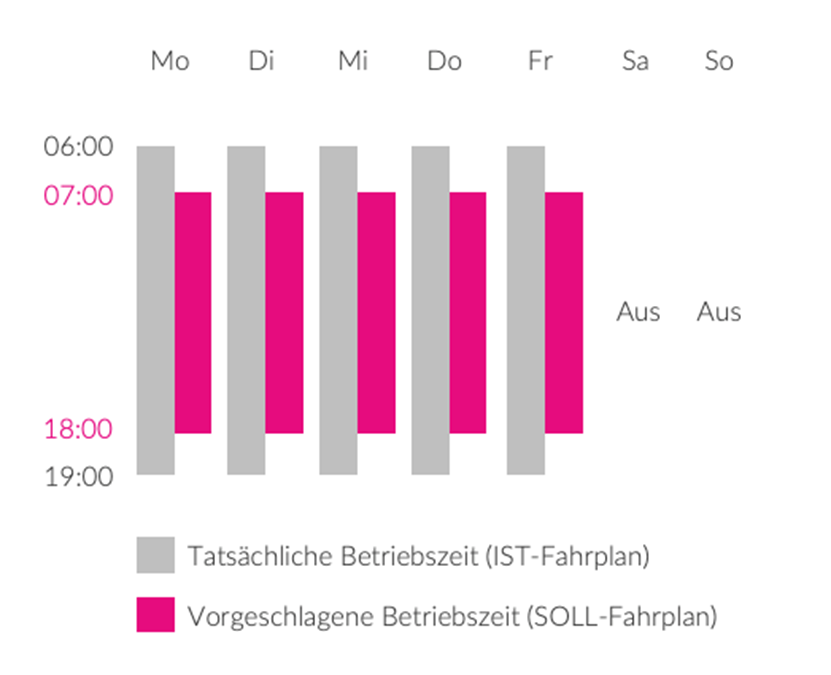
The system control is carried out by switching the systems on and off based on a predefined schedule.
Benefits
- Energy Saving: reduces operating times by shutting down systems, e.g., on weekends, public holidays, or company holidays
- User-friendliness: easy setup and adjustment in the frontend
CURV (Heating Curve)
Heating / Cooling Curve incl. Night Setback
Function
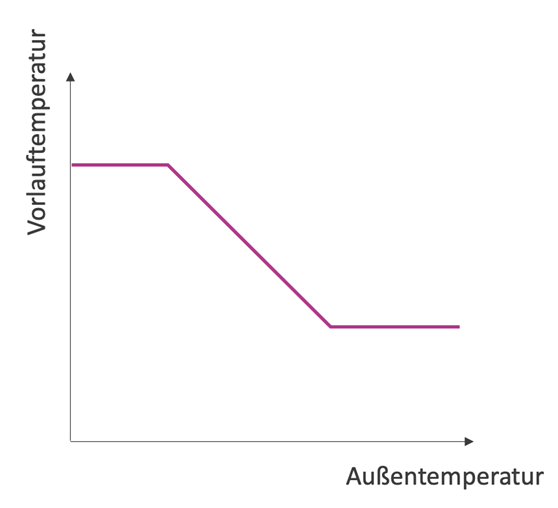
The heating curve algorithm dynamically adjusts the flow temperature setpoints to the outside temperature – in the predictive variation to the weather forecast. This achieves energy savings, avoids inefficient static setpoints and improves room comfort.
Benefits
- Optimization: Adjustment of supply temperatures to the weather conditions.
- Energy Saving: Night setback for inactive schedules.
- Predictive Control: Uses the mean outside temperature forecast for the next 24 hours instead of the current value. Particularly effective for systems with high thermal inertia, such as underfloor heating, to prevent overshoots and increase efficiency.
FROG (Free Cooling)
Optimised operation of ventilation systems
Function:
The free-cooling algorithm uses cool night air to reduce the building temperature and minimise energy consumption while ensuring the comfort of users.
Benefits
- Energy Saving: Activates the ventilation unit at night when the outside air is clearly colder than the building's return air, reducing the need for energy-intensive chillers (like compression chillers) during the day.
- Comfort: Prevents uncomfortably cold or warm offices in the morning.
- Environmentally Friendly: Practical solution for buildings with high cooling requirements in summer.
HERO (Heat Recovery Optimisation)
Optimized Operation of Ventilation Systems
Function
The HERO algorithm calculates the most efficient supply air temperature for a ventilation unit that can be used for both heating and cooling a building. The supply air temperature is dynamically adjusted to optimally control the exhaust air temperature:
- If the exhaust air temperature is too low, the supply air temperature is increased.
- If the exhaust air temperature is too high, the supply air temperature is decreased.
This control loop continues until heat recovery is maximally utilized and active heating or cooling can be avoided.
Added Value
- Energy Savings: Minimizes heat loss and reduces energy consumption through optimized heat recovery.
- Cost Efficiency: Avoids unnecessary heating or cooling processes and lowers operating costs.
- Comfort: Ensures a consistent temperature in the building without additional strain on radiators or cooling systems.
WASP (Weather-predictive Temperation-Mode Setter)
Optimized Operation of Cooling/Heating Systems
Function
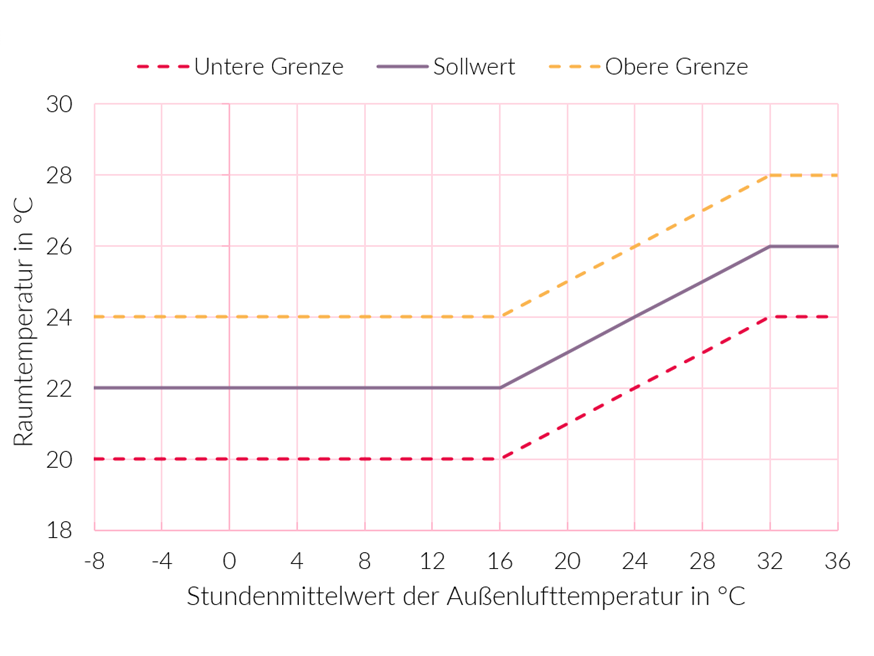
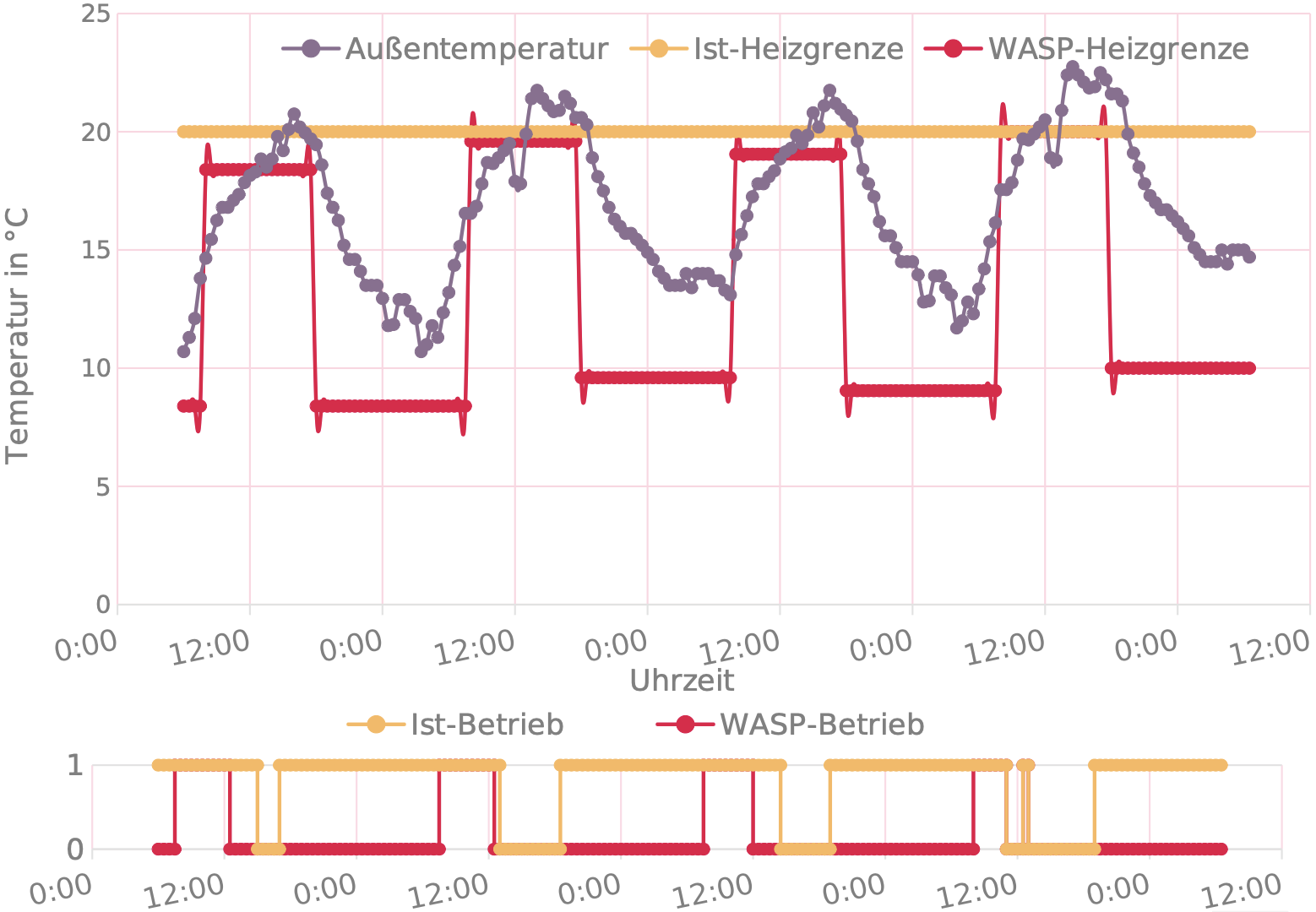
The WASP algorithm optimizes heating and cooling systems with high thermal inertia by dynamically adjusting the heating and cooling limits based on the weather forecast for the working hours (8 a.m.–6 p.m.).
- Prevents inefficient heating and cooling cycles through precise decision making between modes.
- The limits are re-evaluated every 15 minutes based on the latest forecast.
- Night setback extends the limits outside the schedule and thus limits operation at night and on weekends, except in extreme weather conditions.
Benefits
- Higher Efficiency: Reduces frequent switching between heating and cooling, which minimizes energy losses, especially in systems like concrete core activation.
- Cost Reduction: Reduces unnecessary activity of heating and cooling systems through predictive control.
- Improved Comfort: Ensures stable temperatures during working hours and prevents temperature fluctuations.
ANT (Anti Pump Blockage Algorithm)
Function
The ANT algorithm activates pumps for a few minutes if they have been switched off for an extended period (e.g., in summer) to prevent potential pump seizure.
- Once a week, a pump that is not running is switched on for five minutes.
Benefits
- Functionality: Protects pumps from seizing if they are switched off for an extended period.
ARA (Adaptive indoor climate algorithm)
Optimized operation of schedule-based systems
Function
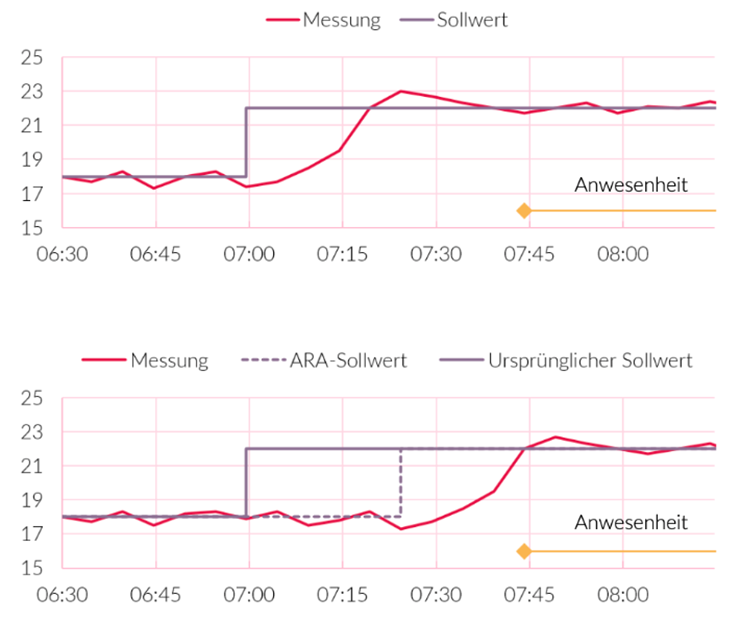
The ARA algorithm learns how long a room needs to reach the desired temperature and adjusts the schedule accordingly.
- Ensures that rooms have the target temperature exactly at the desired time.
- Optimizes operation by precisely timing the heating or cooling process.
Benefits
- Improved Comfort: Rooms are comfortably tempered at the right time, without delay.
- Energy savings: Minimizes energy losses compared to fixed schedules.
- Reduced Peak loads: Since each room gets its own individual lead time, consumers tend to start at staggered times rather than all at once.
BEE (Blind Control Algorithm)
Function
The Blind Control algorithm determines the optimal position of blinds in a building to improve energy efficiency and comfort.
- Uses blinds at night to store heat in winter or dissipate it in summer.
- Adjusts the blinds to optimize solar gains by increasing or reducing light incidence.
- Delays automatic adjustments to account for manual changes by users.
Benefits
- Energy efficiency: Reduces heating and cooling demand through targeted use of solar energy and insulation.
- Improved comfort: Ensures uniform room temperatures and minimizes unwanted heat gains or losses.
- Versatility: Suitable for all buildings with blinds controllable via our platform.
ORC (Optimized Room Climate Algorithm)
Function
The ORC algorithm corrects unfavorable temperature settings made due to short-term discomfort caused by weather conditions.
- Automatically resets user adjustments to the base setpoint once per night if doing so saves energy.
- Uses fixed standard setpoints provided by the room control devices, from which users can only deviate within a defined range.
Benefits
- Energy efficiency: Prevents inefficient settings in the long term and saves energy.
- Improved comfort: Ensures that the room climate returns to a comfortable and efficient level.
- User-friendliness: Automatic adjustment without additional effort for users.
PUMA (Pump Modulation Algorithm)
Function
The PUMA algorithm dynamically adjusts the head of pumps in heating and cooling circuits based on user parameters and weather forecasts.
- Reduces the head of pumps when heating demand is reduced or outdoor temperatures are higher.
- Switches off the pump when there is no heating demand.
Benefits
- Energy Efficiency: Reduces the pump's power consumption and thermal energy consumption through precise heat distribution.
SHAPE (Spot-based HVAC Air Pressure & Temperature)
Load shifting in air handling units
Function
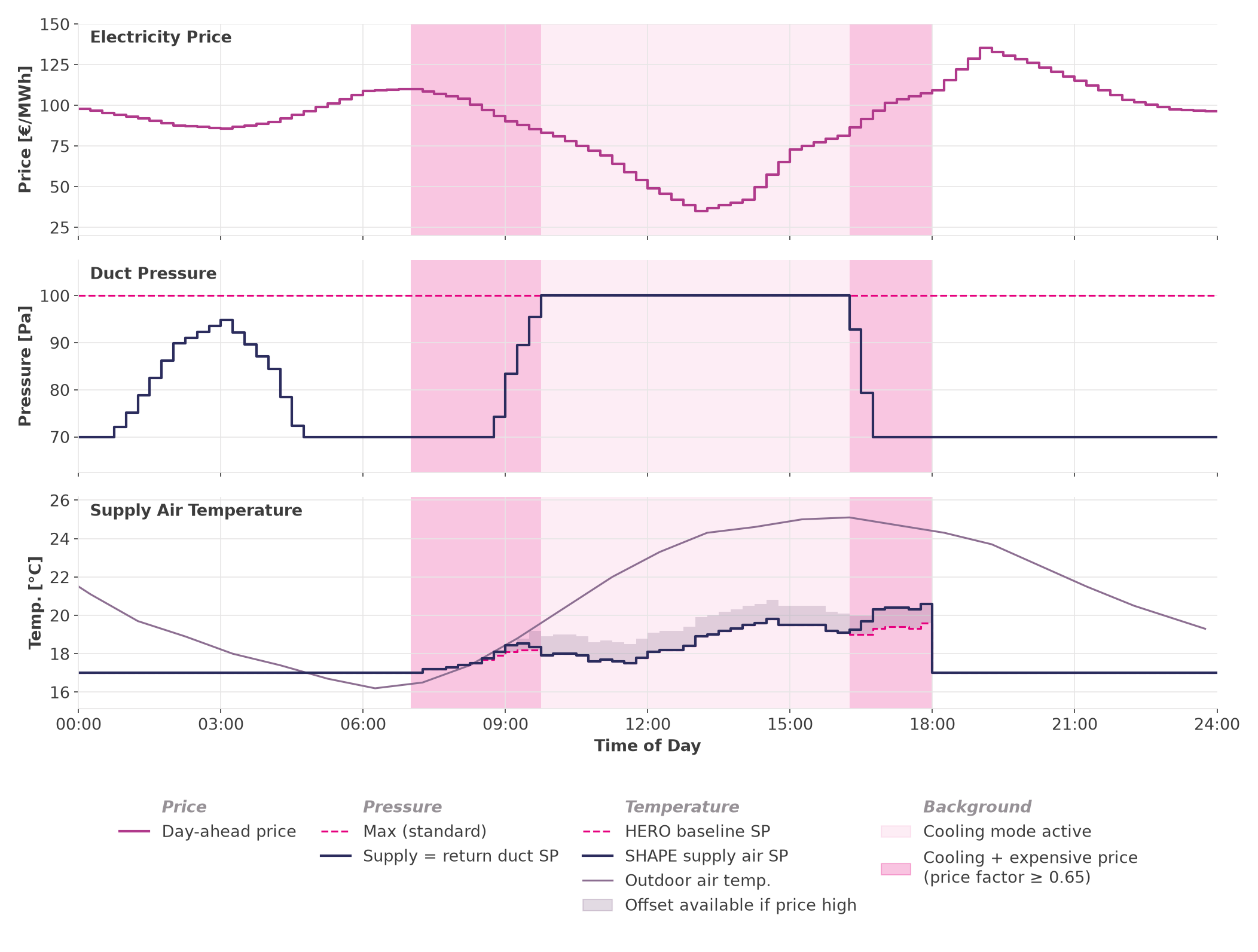
The SHAPE app uses price fluctuations on the day-ahead electricity market to reduce the electrical load of ventilation systems during expensive hours. To do this, it continuously adjusts duct pressure and supply air temperature to the current electricity price:
- Electricity price: Every 15 minutes, SHAPE compares the current price with the lowest and highest price of the day between 5 a.m. and 6 p.m.
- Duct pressure: As long as the price is below the median of this time window, supply and extract duct pressure stay at the configured maximum. Once the price reaches the top 35 % of the price range, SHAPE lowers the pressure continuously. From the top 20 % onward, it sits at the configured minimum.
- Supply air temperature: The starting point is a supply air temperature setpoint that SHAPE calculates using the HERO logic. In cooling mode, SHAPE raises this setpoint by up to 1 K when electricity prices are high, but never above the outdoor temperature. This way, the cooling coil has less work to do.
Benefits
- Lower electricity costs: Fans and cooling use less electricity when it is most expensive.
- Clear limits: The duct pressure always stays between the configured minimum and maximum.
- HERO included: The heat recovery optimization of HERO is already built in.
SLOTH (Slope Optimization for Thermal Heat Transfer)
Peak load shedding for heating circuits
Function
The SLOTH app distributes heating power demand over a longer period by gradually raising the supply temperature setpoint along a defined ramp instead of increasing it in a single step. The calculation of the supply temperature occurs in two steps:
- Heating curve calculation: Calculates the target supply temperature setpoint using a heating curve based on the current and forecast outdoor temperature.
- Ramp calculation: Limits each increase of the supply temperature setpoint to the current supply temperature + 5 K per 15-minute interval, thus converting the step change of the calculated target supply temperature setpoint into a gradual ramp that approaches the target supply temperature value. The maximum increase of 5 K is a default value and can be adjusted for each heating circuit.
Benefits
- Reduction of operating costs: Prevents avoidable costs due to thermal load peaks in the morning at the start of use.
- Energy efficiency: Night setback reduces the flow temperature‑setpoint outside operating hours and reduces energy demand
- Versatility: Suitable for any heating circuit supplied by a heat pump or district heating connection.
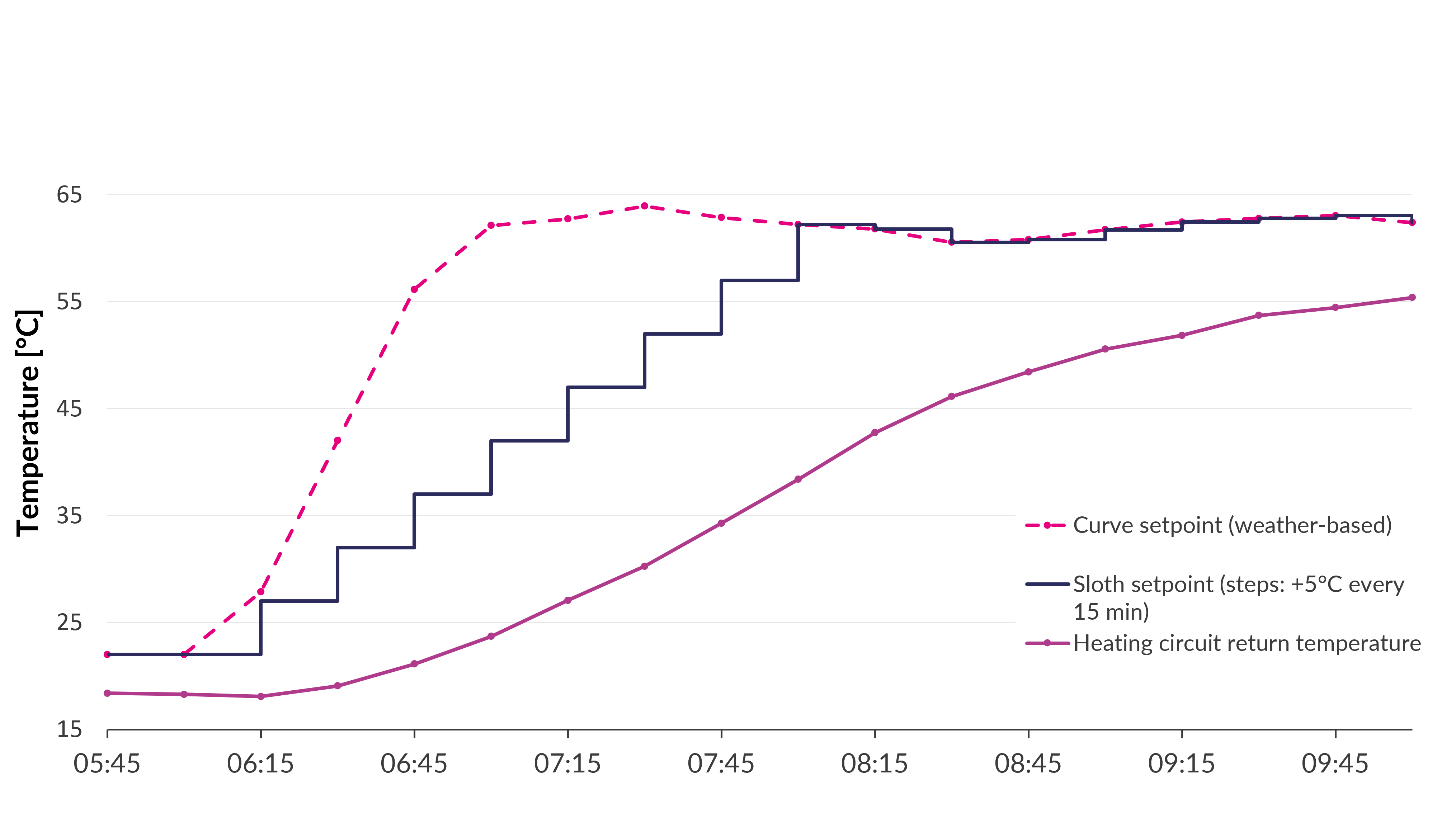
Behavior of the SLOTH ramp during the morning heating phase: Instead of raising the flow temperature setpoint to the heating curve target in a single step (dashed line), SLOTH limits each 15-minute increase to T_IN + 5 K ( 5 K is configurable, solid blue line). This creates a continuous rise that distributes the heating power demand over time and reduces the peak load.
SPOT (Spot Market Price-Based Setpoint Interpolation)
Load shifting in cooling circuits
Function
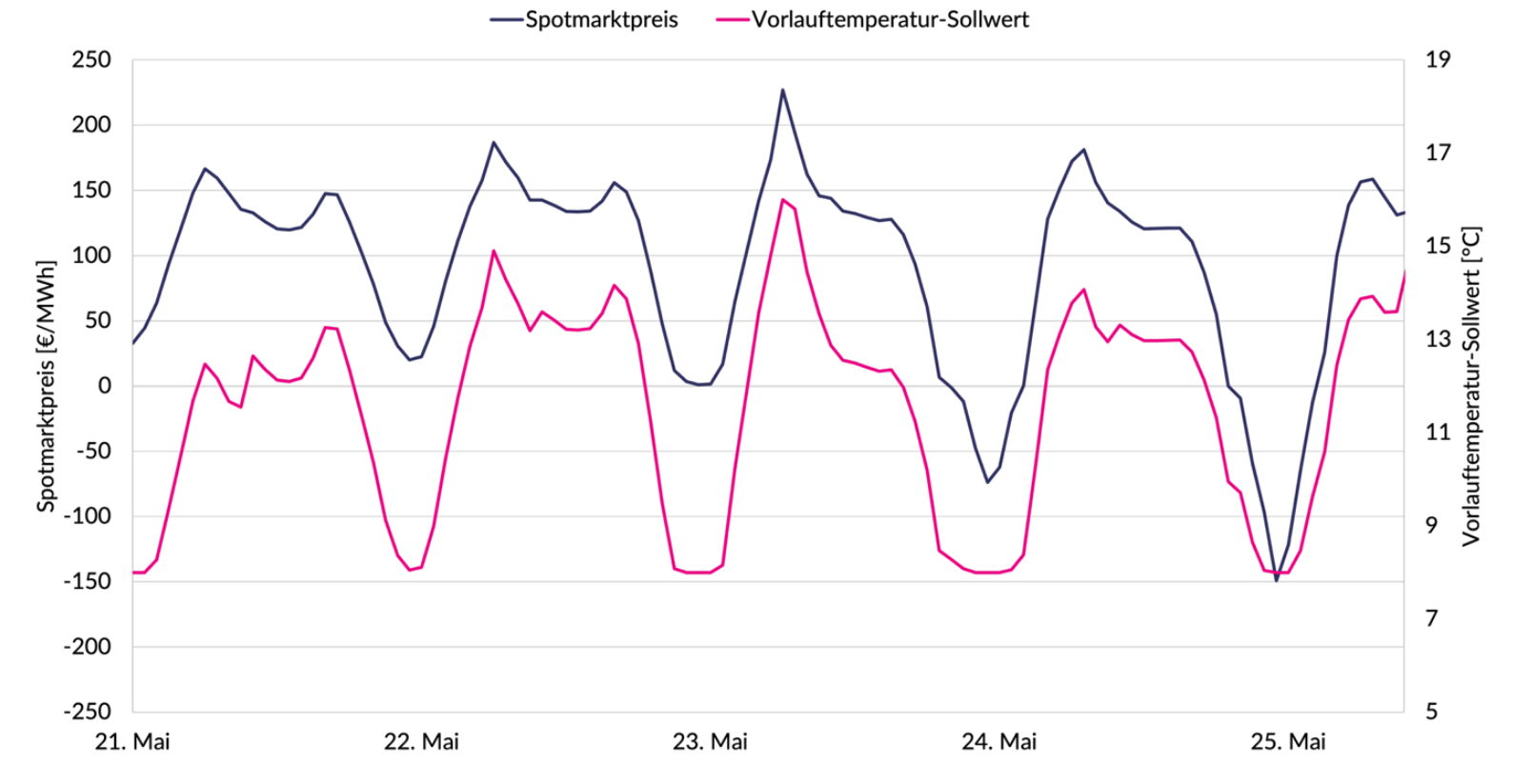
The SPOT algorithm shifts a building's cooling load to low-price phases by interpolating flow temperature setpoints based on spot market electricity prices.
- Enables systematic electricity cost reduction without compromising comfort or building operation
- Optionally protects systems where the dew point of the surrounding air is critical.
Benefits
- Cost Savings: Reduces electricity costs in buildings where electricity is sourced via dynamic tariffs, power purchase agreements with variable price components, or from one's own photovoltaic system.
- Reduces CO2 Emissions: Enables electricity consumption during times with a high proportion of renewable energies in the grid.
- Grid Serviceability: Contributes to grid stability and supports demand-side management.