
Savings potential through efficient recovery systems (HRCS)
This section focuses on the efficient use of the heat recovery system (HRCS) in air handling units (AHUs). Targeted optimization or troubleshooting can significantly reduce energy consumption.
Function
The Temperature Efficiency analysis examines the performance of the heat recovery system within the Air Handling Unit component.
It uses temperature measurements of the airflows entering and leaving the HR system — return air, outside air, and optionally supply air after heat recovery or exhaust air — to calculate the actual temperature efficiency.
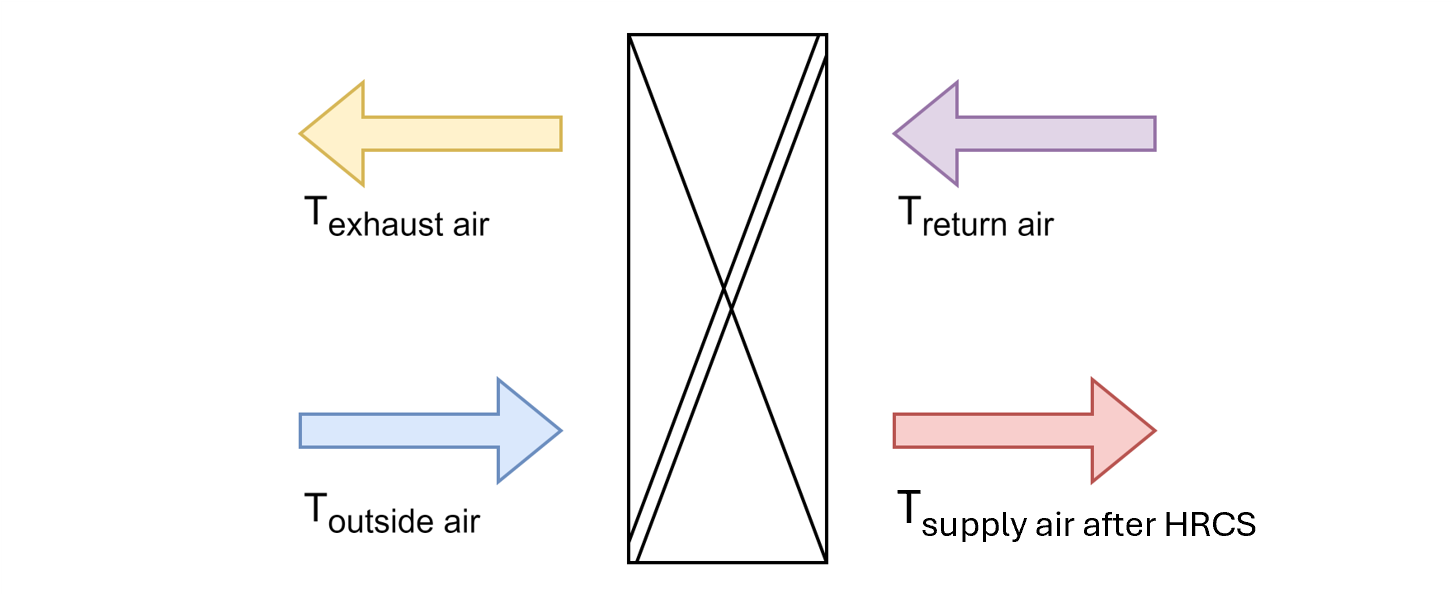
The temperature efficiency value describes the ratio between the actual recovered heat energy and the theoretically maximum possible value. A high temperature efficiency indicates effective heat recovery and therefore a low additional heating demand.
The analysis also automatically detects whether the HERO .controls App (Heat Recovery Optimization) is already active or whether its use would be beneficial. The HERO .controls App continuously monitors the utilization of the heat recovery system, intelligently adjusts setpoints, and thus ensures maximum energy recovery with minimal heating energy demand.
Potential savings are quantified by analyzing the measured temperature efficiency over a reference period and calculating the additional thermal energy that the HR system could recover under optimal operation. This value is then extrapolated to a full calendar year using climate-normalized data.
Two types of savings potentials are identified:
- Savings through more efficient HRCS utilization
Energy that could be saved through full utilization of the HRCS. During periods of suboptimal operation, the HRCS recovers less heat than possible. The savings potential corresponds to the additional energy that could be recovered if the HRCS were operated optimally.
This can, for example, be achieved through the use of the HERO .controls App. - Savings through correction of physical defects
Energy losses that occur when the measured efficiency of the HR system is significantly below its nominal performance (more than 5 percentage points).
This indicates a possible physical defect in the HRCS that should be inspected.
Added Value
- Identification of suboptimal use of heat recovery and the associated energy losses
- Detection of active use or evaluation of potential use of the HERO .controls App
- Detection of physical defects if the HRCS operates below its nominal specification
- Calculation of savings potential through optimization of HRCS utilization
- Annualized estimation of savings potential using heating degree hours
Requirements
1. Temperature mapping
To calculate temperature efficiency, temperature data points are required.
The following pins must be assigned to the Air Handling Unit (AHU) component:
- Return air temperature
- Outside air temperature
- Supply air temperature after heat recovery or exhaust air temperature
2. HRCS utilization
To calculate HRCS efficiency, the signal for HRCS utilization must be available.
- Heat recovery system position or heat recovery system control signal
3. Performance data
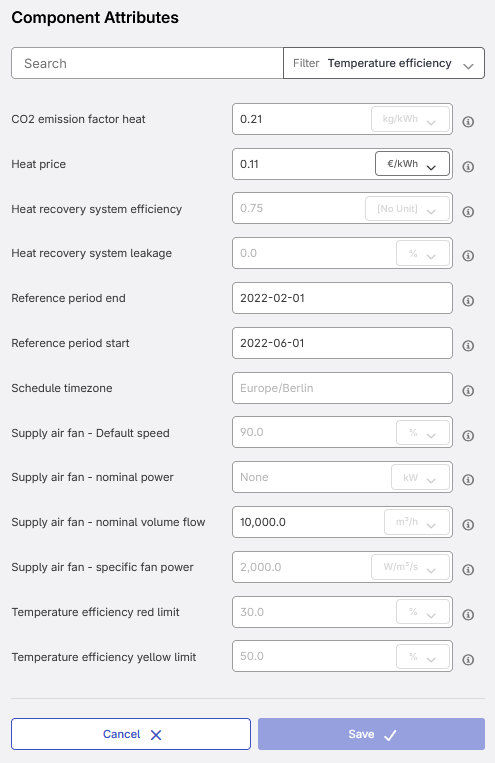
To calculate savings potential, information on the power or volume flow of the supply and/or return air fan must be available. Assign at least one of the following pins/attributes:
- Supply air fan nominal power (attribute)
- Supply air fan nominal volume flow (attribute)
- Supply air fan volume flow (pin)
4. Energy prices and CO₂ emission factor
To convert energy savings into financial and CO₂ savings, the following values must be provided:
- Heat price
- CO₂ emission factor for heat
These can be stored either on the Air Handling Unit component or on the higher-level Building component.
5. Attribute adjustments (optional)
Adjusting certain attributes can improve the accuracy of the analysis:
- Heat recovery system efficiency
- Heat recovery system leakage
- Reference period start
- Reference period end
Result
The following key performance indicators (KPIs) help interpret the analysis results:
KPI | Example |
|---|---|
temperature efficiency.mean | 65 % |
temperature efficiency.optimal hrcs utilization.reference period.mean | 80 % |
temperature efficiency.suboptimal hrcs utilization.reference period.mean | 20 % |
operating time.optimal hrcs utilization.reference period.relative | 75 % |
operating time.suboptimal hrcs utilization.reference period.relative | 25 % |
yearly savings potential.HERO.energy.heat | 30 000 kWh |
yearly savings potential.HERO.financial.heat | 3 300 € |
yearly savings potential.HERO.CO2 emissions.heat | 6 300 kg |
yearly savings potential.physical defect.energy.heat* | 20 000 kWh |
yearly savings potential.physical defect.financial.heat* | 2 200 € |
yearly savings potential.physical defect.CO2 emissions.heat* | 4 200 kg |
yearly savings potential.total.energy | 50 000 kWh |
yearly savings potential.total.financial | 5 500 € |
yearly savings potential.total.CO2 emissions | 10 500 kg |
* Displayed only if a physical defect is detected (measured optimal efficiency is more than 5 percentage points below the nominal value).